The Tracy System of Kenpo
Jiu-Jitsu IS self-defense—it is not a
sport. It is not simply a plaything like
the martial arts of too many systems and styles that cannot actually be used in reality
when you really need it—when your life is in danger.
The Tracy System of Kenpo
Jiu-Jitsu IS self-defense—it is not a
sport. It is not simply a plaything like
the martial arts of too many systems and styles that cannot actually be used in reality
when you really need it—when your life is in danger.
Since the beginning of time, unarmed fighting has for most
of the Western World been little more than rough and tumble brawling.
In the 19th century the Marquise of Queensberry introduced
some civility into spectator fighting, and gave rise to professional
boxing.
But few men, and virtually no women learned how to “Box.”
Savate was cultivated as French foot-fighting when, as tradition holds,
French sailors observed Chinese “Boxers.”
The Boxer Rebellion of 1899-1900, and America’s Gunboat Diplomacy put
American servicemen in contact, and often fights, with Oriental forms of unarmed
fighting. Jiu-Jitsu (Ju-Jitsu) and
Judo became popular when
Theodore “Teddy” Roosevelt, the 26th U.S.
President, learned Judo giving
Jigoro Kano, the founder of Judo, the
international acceptance Judo needed. But
Judo and Jiu-Jitsu practitioners were few in number.
This influence, however, gave rise to the military form of hand-to-hand
combat called “Combat Judo.”
Karate first appeared in America in the early 1930’s but
it was relatively unknown until American servicemen began returning from the
occupied post-war Japan. Then with
the advent of the Korean War, hundreds of thousands of soldiers were sent to
Japan as support troops. Most of
these servicemen learned Karate, because McArthur forbid Judo, but not Karate.
But the fighting style of the western world was still a "style without
style"—rough and tumble brawling. One
need only look at the movies of the early 20th century to see how the
western world fought. Fighting in
films was a shadowy mirror of how people acted and fought.
Ju-jitsu had developed as a Japanese combat martial art
over many centuries of use in actual warfare and gave birth to Judo, which was a
much more gentle way. These arts
were superb forms of self-defense in Japan.
But Judo was virtually useless against a trained Boxer, as many Judo
instructors discovered when American Boxers would challenge them.
Almost every American who trained in Judo in the ten years after WWII
would tell a story of how he had grabbed an attacker by the coat lapel to throw
him, only to find himself getting hit as he held a torn, empty coat in his hand.
Japanese Karate was not much better.
It was still, linear, and direct. It
worked well against the untrained, but Boxers and street fighters found it
useless against them. There were
many contests between Boxers and Karate men in Japan and Korea after the war.
The Karate-ka was allowed to use his hands and feet, without gloves,
while the boxer wore gloves and followed boxing rules.
Even despite these obvious disparities, the boxer almost always won.
When the boxer was allowed to fight without gloves, the match seldom
lasted beyond 30 seconds.
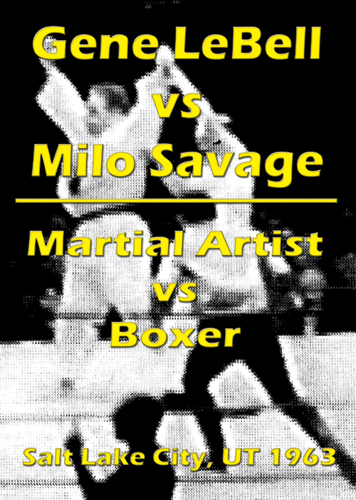
 Judo
versus Boxing matches often produced the same results.
However, in those matches, the Boxer was not only required to wear
gloves, but also a heavy Judo Gi. “Judo”
Gene LeBell is the only person who ever legitimately beat a boxer in such a
match in 1963. Gene, however, was an
exceptional man, a professional wrestler, an expert martial artist, and it was
not to his disadvantage that he was over 6 feet tall and weighed over 220
pounds.
Judo
versus Boxing matches often produced the same results.
However, in those matches, the Boxer was not only required to wear
gloves, but also a heavy Judo Gi. “Judo”
Gene LeBell is the only person who ever legitimately beat a boxer in such a
match in 1963. Gene, however, was an
exceptional man, a professional wrestler, an expert martial artist, and it was
not to his disadvantage that he was over 6 feet tall and weighed over 220
pounds.
Jiu-Jitsu versus Boxer matches were quite another thing, as
the Jiu-Jitsu fighter would simply shoot-in in a low stance, taking the first
punch to his back as he grabbed the legs and took the helpless Boxer down to
choke him out.
It is little wonder then that the Kenpo Jiu-Jitsu, which
Hawaiian-born, Japanese-raised James Mitose of the Yoshida Clan, began teaching
shortly after WWII was so effective as a form of self-defense.
Even though Mitose’s style of Kenpo had been handed down in his family
for over 700 years in Japan, it had originated in China, where “Boxing” and
kicking together were accepted forms of fighting. It is the preservation
of this art that sets Tracy's Kenpo apart from all other forms of Kenpo.

Kenpo Jiu-Jitsu is an art created by ancient Samurai Warriors of Japan, to deal with the most severe self-defense situations. It is the only self-defense art taught today that is designed to protect the individual by any and all means necessary.
Kenpo, by its powerful philosophy and devastating hand techniques, enables the individual to use enough force necessary to dissuade, disable, injure, or neutralize the assailant.
Many styles and many terms synonymous with martial arts
and specifically Kenpo exist today. While
the word Karate is a more modern term, with actually two different
meanings, Kung Fu and even Kickboxing are also terms used to describe this
fascinating method of oriental self-defense.
However, all of these styles are considered oriental forms of
boxing (striking), whereas Jiu-jitsu, Judo, Aikido, and T’ai-chi
ch’uan are oriental methods of wrestling (grappling).
Practitioners of Kenpo Jiu-Jitsu are enthusiastic
adherents of combinations of punches, strikes and kicks, blended with
throws, holds, takedowns and other compliance techniques.
Unlike most systems their training goes beyond the “one block,
one punch” theory. Working
on combinations of five or more movements, they contemplate probable
counters that may thwart their opponent’s efforts.
This realistic approach eradicates thoughts of underestimating an
opponent’s ability to take punishment or overestimating their own
ability. They learn practical
and effective movements that can have immediate effect and are not just
untried theories on paper. They
also learn that combinations can be changed instantly to fit a specific
situation and do not necessarily have to follow a set pattern.
Chances of panic in a real crisis are considerably lessened because
they are taught how to cope with our modern day methods of fighting
realistically, logically, systematically and effectively.
Training—Instruction
At Tracy’s Kenpo Studios, all beginners are given
instruction in basic stances, blocks, punches, kicks, throws, joint-locks,
chokes and takedowns.
Everyone enrolled is classified as a novice regardless of previous
training; and must therefore spend approximately three months in the
beginner class. As the student progresses, they are taught various techniques
including defenses against grabs, punches and kicks. They learn the location of vital points on the body and
how to use their natural weapons to their maximum.
Greater stamina, concentration and coordination are
required of those in the intermediate class.
The student is taught to become proficient in designated
“forms” resembling a graceful ballet.
Within these dance-like movements are various defensive and
offensive combinations amalgamated into fluid and continuous sequences.
The forms become more complex and contain highly skilled techniques
that require greater balance and agility.
With detailed training, the student learns to defend himself
against a club, knife or gun. Handling
three or more attackers then becomes an achievable task.
A student considered competent by their instructor is
placed in the advanced class. Again
they are taught higher skills along with the theory and philosophy.
Now their ability is put to an actual test.
They are often asked to spar with fellow students and are required
to stop their blows just prior to contact.
Precision, economy of motion and accuracy become a normal and
integral part of their reflexes. Thus
a serious student discovers that the perfection of Kenpo can be a lifetime
endeavor.
Theory—Philosophy
One cannot realize the deadliness, speed and incredible
power of Kenpo Jiu-Jitsu without witnessing an actual demonstration.
Utilizing principles of physics and leverage, the Kenpo
practitioner is able to strike a penetrating blow to a small vital target
with whip-like speed. After
learning to return a blow at a greater speed than delivered it is
improbable that an adversary could grab the striking hand or foot.
By learning combinations, the Kenpo student makes it extremely
difficult for an opponent to block all of their blows.
Using correct breath control, all of the person’s strength is
released at the moment of impact. An
expert in Kenpo Jiu-Jitsu can easily split a stack of one-inch boards with
the bare knuckles or shatter solid bricks with the “knife-edge” of
their hand.
However, the Kenpo practitioner is basically passive.
The true philosophy of Kenpo is embodied in its creed.
Because of their accomplishments, the standards by which they live
dictates that the student of Kenpo does not seek trouble; nevertheless,
they expect it and are prepared. By
exercising control a person proficient in Kenpo Karate need not
permanently injure an aggressor, but merely render them incapable of
attack. With confidence in
their abilities, fear is banished and trouble avoided.
The ultimate goal of the Kenpo practitioner is one of humility and
restraint.
Conscientious students inevitably qualify for promotion
and are judged according to specific Kenpo criteria.
In time, one’s performance and ability will correspond to one of
several proficiency levels maintained by the school.
These levels are distinguished by a graded belt
system.
Advancement is dependant upon the student’s own efforts.
Many factors are considered for advancement, including an analysis
of the prospect’s character.
The color of the belts consists of white (for
beginners), brown (more advanced) and black (highly skilled).
There are varying degrees within each category; for example the
yellow, orange, purple, blue and green belts are representative of the
degrees, or “Kyu” (steps) of white.
Belts
awarded by other schools are not honored, as the requirements and
curriculum vary greatly from each style and system to another, so there is
no comparison possible.


























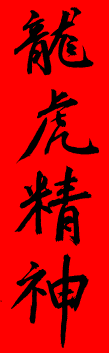
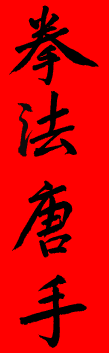 One
characteristic common to the Oriental languages is their use of the same
written characters; however, the way the written characters are
pronounced make the spoken languages completely different from one
country to another, or even from one part of the country to another.
China is a classic example, with two major dialects: Mandarin (the
official dialect) and Cantonese, plus hundreds of local dialects.
It was this type of diversification which led to the development of so
many different martial arts styles in China. There are over 300
styles of "Kung-fu" taught in China today.
One
characteristic common to the Oriental languages is their use of the same
written characters; however, the way the written characters are
pronounced make the spoken languages completely different from one
country to another, or even from one part of the country to another.
China is a classic example, with two major dialects: Mandarin (the
official dialect) and Cantonese, plus hundreds of local dialects.
It was this type of diversification which led to the development of so
many different martial arts styles in China. There are over 300
styles of "Kung-fu" taught in China today.
 Kenpo has been described many ways, but the term "
 The confusion lies in the fact that the actual word "karate" is a
"homonym": a word with the same pronunciation as another but with
a different meaning, origin, and, usually, spelling. When written
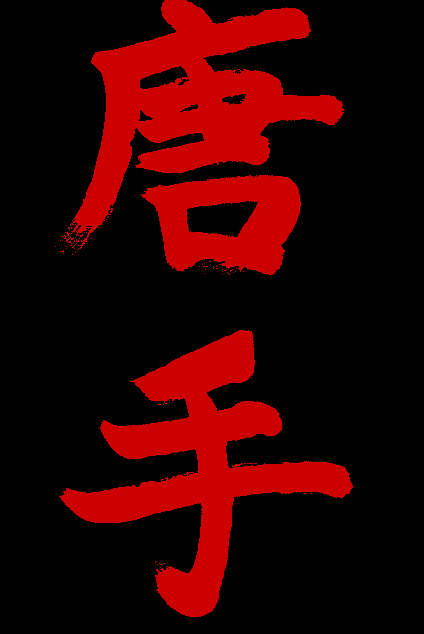
in its original form of 唐手, (the one we
use) it means "China Hands" or "T'ang Hands" (pronounced "tong"—remember "Tang" is a breakfast drink) referring to the "T'ang
Dynasty" (618-960 A.D.) or—more literally—China. This again
distinguishes it as a completely different art from "Karate" meaning
"empty hands".
The confusion lies in the fact that the actual word "karate" is a
"homonym": a word with the same pronunciation as another but with
a different meaning, origin, and, usually, spelling. When written
in its original form of 唐手, (the one we
use) it means "China Hands" or "T'ang Hands" (pronounced "tong"—remember "Tang" is a breakfast drink) referring to the "T'ang
Dynasty" (618-960 A.D.) or—more literally—China. This again
distinguishes it as a completely different art from "Karate" meaning
"empty hands".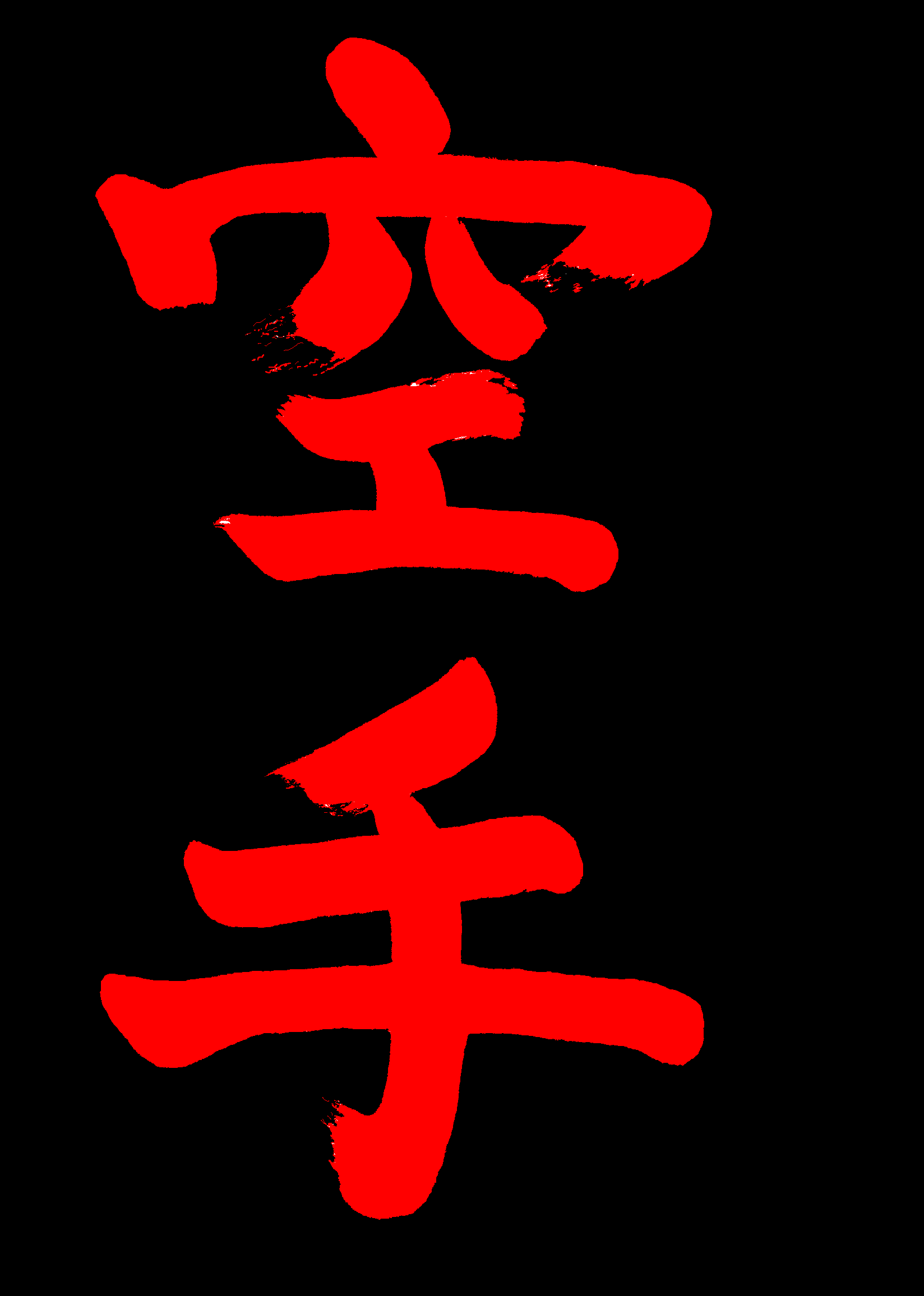 The second meaning—the one used by the Japanese and Okinawans, and
the one which causes the most confusion because it is the one most commonly referred to in America—is 空手, "
The second meaning—the one used by the Japanese and Okinawans, and
the one which causes the most confusion because it is the one most commonly referred to in America—is 空手, "